More than one million young people not in work or education, says ONS

The number of young people neither working nor learning has jumped beyond one million for the first time since 2013, official figures have revealed ahead of a review which will warn over fears of a “lost generation”.
The Office for National Statistics said the number of people aged between 16 and 24 and not in employment, education or training – so-called Neets – rose to 1.01 million in the three months from January to March.
It is the highest level since the three months to December 2013, when the figures were calculated with a different methodology, and also represent a 55,000 increase compared with the previous quarter.
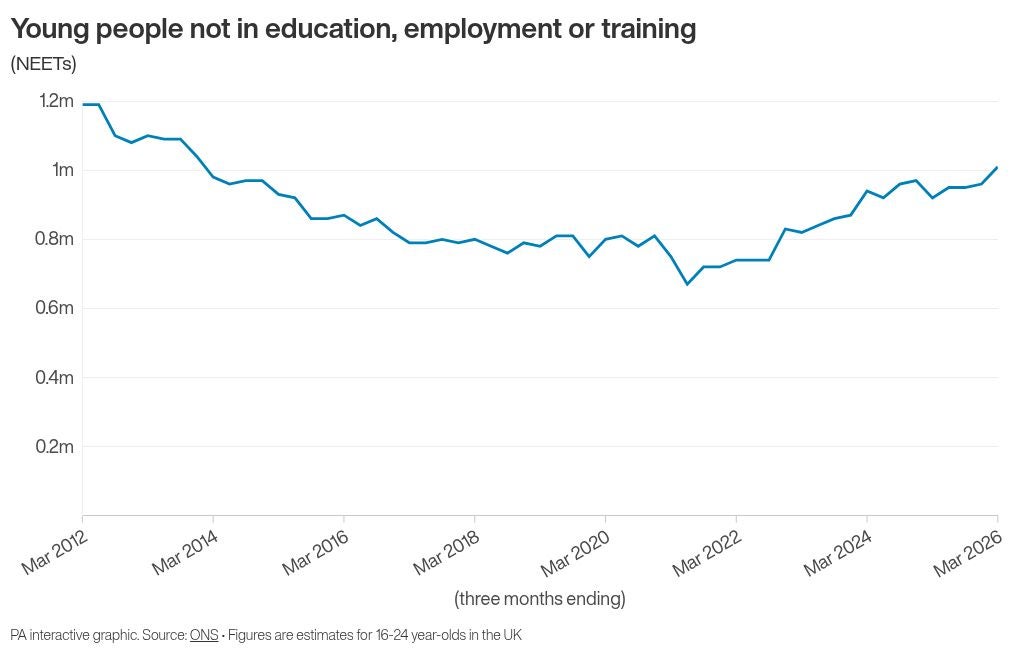
The data showed that 613,000 of these young people were considered economically inactive – meaning they are unable to work or not seeking work – over the period, marking a record high.
Elise Rohan, head of labour market output at the ONS, said: “The number of young people not in employment, education or training rose above one million in the first quarter of 2026, to its highest level in more than 12 years.
“This was driven by greater numbers of young people no longer looking for work.”
Later on Thursday, review author Alan Milburn is expected to say the first rung of the career ladder is “simply out of reach” for many young people, and conclude it is not this group’s fault but rather “failure of a system stuck in the past”.
Mr Milburn, who is leading the review of the Neets crisis for the Government, will publish his interim report on Thursday.
It will warn that the number of Neets could reach 1.25 million within the next five years without policy action.
The former Labour Cabinet minister has already spoken about some of his findings, warning at the weekend of a “bedroom generation” and saying anxiety linked to social media is driving economic inactivity among young people.
Publishing his report, he is expected to say: “Six in 10 have never had a job. Twenty years ago, that figure was closer to four in 10.
“Detachment is no longer temporary. For too many young people it is becoming permanent. We are at risk of a lost generation.”
Thursday’s data means that 13.5% of all young people were not in employment or education, up 1 percentage point compared with a year ago.

Mr Milburn will say: “The first rung of the career ladder has thinned. For too many young people it is now simply out of reach.
“That places them in a hopeless Catch-22 where employers ask for work experience but the opportunities for young people to gain it have narrowed or gone.”
He is expected to call for urgent action and tell the Government the issue “should be the priority”.
He will say: “This is not a failure of young people. It is a failure of a system stuck in the past.
“Whether it is education or health or welfare, that system fails to enable their participation in the labour market.
“Instead, all too often it ends up putting young people on a path to a life not in jobs but on benefits.
“This should be the priority for the Government. It should be the priority for all of us.”
He said the problem was made worse for young people by frequent rejection by employers, and not hearing back about jobs.

Mr Milburn told LBC: “They’re putting in dozens, sometimes hundreds of applications, hear nothing back by the way, and it’s the silence that kills because it dents their confidence and it dents their hope.”
The review is expected to state that 84% of Neets surveyed said they wanted a job or training, which it said challenges the narrative that young people do not want to work.
The research also found that for every £1 spent on employment support for young people, around £25 was spent on benefits, which it describes as a “fundamental imbalance in how public money is spent”.
The report is expected to set out how entry level jobs have been in sharp decline with 1.6 million fewer low and medium skilled jobs in the economy, making it difficult for people to get into the jobs market.
It will say vacancies in hospitality have halved in the last four years alone while so-called “Saturday jobs” have long been declining and apprenticeship starts among young people have plummeted 35% in the past decade.
Mr Milburn also raised concern about the impact of artificial intelligence, and said it was the reason to make swift changes.
He told Good Morning Britain: “The AI revolution really is starting to bite, but it hasn’t fully bitten, and that’s why we can’t just wait and say this is going to be 10 years. We’ve got to start taking action now.”
While this report is expected to set out why the system is seen to be failing young people and what the situation will lead to if nothing changes, recommendations for fundamental reform are not expected until later this year.

Work and Pensions Secretary Pat McFadden has previously said the impact of youth unemployment could scar people for the rest of their lives, branding it a “a quiet crisis, a ticking timebomb, which risks their future working lives”.
It was reported he will announce plans for 300,000 extra work experience placements over the next three years, with the DWP saying the Government is keen to “give every young person the best start in their career”.
Mr McFadden said: “I commissioned this report because we cannot afford to lose a generation of young people, and I welcome Alan Milburn’s vital work which lays bare the scale of the challenge and the root causes of youth unemployment we now need to confront.”
He pledged to “work across government and with employers, charities and young people to drive real change, so more young people are earning or learning, not left behind”.
Marks & Spencer chief executive Stuart Machin said the report “lays bare the joblessness crisis facing a generation of young people”, warning that the findings are “shocking but not surprising”.
The Institute for Public Policy Research (IPPR) said the report shows “an entire generation is being let down” and that the system “is not doing enough to help them build confidence, gain experience or find a secure route into employment”.
