Greens urge SNP to introduce ‘Amazon tax’ on big online businesses

Want to bookmark your favourite articles and stories to read or reference later? Start your Independent Membership today.
Join today
Already a member?
Log in
The Greens have called on the Scottish Government to introduce an “Amazon tax” on big online retailers.
The party said the levy would ensure large, predominantly, online-based retail businesses pay more to the communities and local economies that host them.
Under their proposals, a surcharge would be added through the Non-Domestic Rates system to firms such as Amazon.

The Greens said it would only apply to large online-based operations such as distribution centres, “to offset the economic damage caused by falling footfall numbers across high streets in Scotland”.
The party said massive companies like Amazon were making “obscene profits” while smaller firms were struggling to survive.
Amazon reportedly earned around £30 billion in UK revenues in 2025 and paid more than £1.3 billion in taxes last year, with the company previously saying it was one of Britain’s top five taxpayers.
Laura Moodie, Green MSP for the South Scotland region, said an “Amazon tax” would allow smaller Scotland-based businesses to compete on a level playing field with giants like Amazon.
She said: “Huge global online retailers are making obscene profits while Scotland’s small businesses are struggling and our high streets are being hollowed out.
“Scotland should be building a tax system that is fair, progressive, and fit for the future, and one crucial way to do this is to level the playing field by making giants like Amazon pay to offset the damage their online businesses have done to local high streets.”
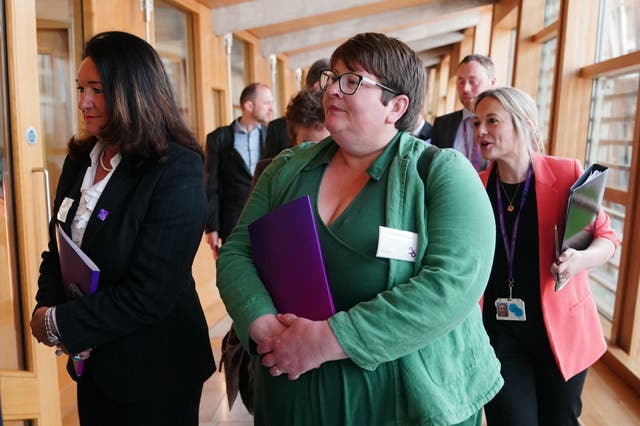
Ms Moodie said firms like Amazon have taken “more and more” from communities “while giving far to little back”, accusing it of “sucking huge amounts of wealth out of Scotland’s communities”.
She added: “We need to rebalance this and give small and independent businesses a level playing field with billionaire firms to help rejuvenate our local communities and make our neighbourhoods into thriving and better places to be.
“A simple and effective way to do this is to make companies like Amazon pay for the economic damage they have caused.”
Ms Moodie said the Scottish Government “must stand up to the global giants who are dominating the market without paying their fair share,” adding that a “simple way to do this is to introduce the Amazon Tax.”
The Scottish Retail Consortium, which represents retail firms, said it was against the Green proposals.
David Lonsdale, director of the trade association, said: “Most retailers of any scale sell online and most have warehouses.
“Warehouses are a fundamental part of a retailer’s operations and are used to house goods before they are transported to stores and customers.
“The idea of new levies on retail warehouses would be deeply alarming, more so as these premises already pay a business rate far above that of equivalent premises in England.
“Scottish ministers should give short shrift to any notion of piling further taxes onto an already overtaxed retail industry.
“Ultimately, the cost of operating a retail business is borne by customers in the prices they pay and so any extra taxes would add pressure onto household budgets.”
A Scottish Government spokesperson said: “The Scottish Government has committed to a comprehensive review of non-domestic rates.
“This will examine improvements and reforms that can be made to the system, working closely with business to ensure the system provides the clarity, incentive and transparency which businesses need.
“Decisions on non-domestic rates and reliefs will be set out as part of the Scottish Budget in the usual manner.
“The Scottish Budget 2026-27 supports business and communities with a package of reliefs worth in excess of an estimated £870 million and almost all (96%) of retail, hospitality and leisure businesses in Scotland can benefit from some form of rates relief.
“The Scottish Government also funds the Small Business Bonus Scheme, to which more than 100,000 properties are eligible, and which remains the most generous scheme of its kind in the UK.”
Amazon refused to comment.
