Why have interest rates risen and what is happening in the economy?

Want to bookmark your favourite articles and stories to read or reference later? Start your Independent Membership today.
Join today
Already a member?
Log in
The Bank of England has hiked interest rates for the first time in more than three years.
The central bank’s policymakers said this was warranted because inflation in the UK economy was rising and would continue to rise as the war in Iran goes on.
It also said that borrowing costs were likely to go up further if there continued to be no resolution to the conflict.
Here, the Press Association looks at what the Bank’s decision means and what could come next.
– What happened to interest rates on Thursday?
Interest rates were raised to 4% from 3.75%.
All nine members of the Bank’s monetary policy committee (MPC) voted for a hike – although one member, Catherine Mann, preferred a bigger jump of 0.5 percentage points.
– What does it actually mean?
The base rate helps dictate how expensive it is to take out a mortgage or a loan.
Interest rates are typically increased in a bid to bring down the rate of inflation, because higher borrowing costs can weigh on demand and therefore cause firms to limit price increases.
The higher base rate means that homeowners on tracker mortgage rates will see an increase to their monthly payments.
People on fixed-rate mortgages will not feel the immediate impact of the hike on their home loan, but it may mean they face increased payments when their deal expires.
Savings rates are also linked to the interest rate, so some will likely go up for some bank customers.

– What is happening with inflation in the UK and why does this influence rates?
Raising interest rates is the central bank’s main way of reducing inflation – the measure of how fast prices increase over time.
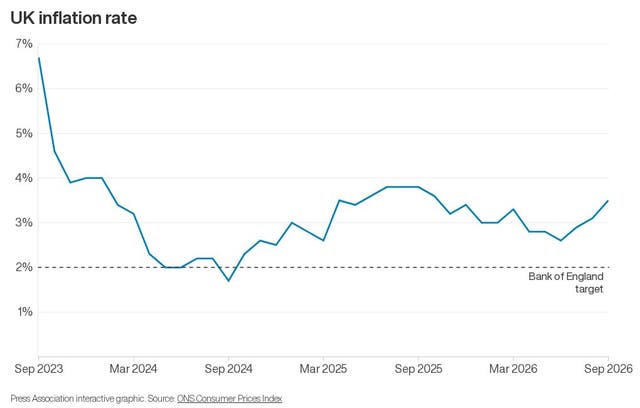
The Bank’s aim is for monetary policy to help keep inflation at 2%, which is the target rate set for it by the Government.
Inflation is currently running above that level, however.
The latest official figures showed Consumer Prices Index (CPI) inflation rose to 3.5% in September, the highest level in 11 months.
The conflict in the Middle East has been a major driving force because disruption to supplies of oil and gas has caused prices to surge, consequentially helping push up household energy and fuel prices.
– What is most likely to happen to inflation in the future?
The Bank of England said on Thursday that it currently expects inflation will accelerate in the coming months before peaking at “around 5%” in the second quarter of 2027.
This is partly because Ofgem’s household energy price cap is forecast to jump by almost 25% in January, pushing average annual bills to £2,150.
But it is also because higher energy prices could feed through into other parts of companies’ supply chains which could be passed onto consumers through the prices charged in shops.
Food inflation has been relatively steady but is expected to accelerate and rise as high as 4.8% next year, meaning higher food bills for households.
– Will interest rates have to rise?
The Bank’s governor Andrew Bailey was clear in the messaging of Thursday’s decision that interest rates will have to increase further if the war in Iran is not resolved.
“Today’s increase shouldn’t be seen as the first in an inevitable long sequence of hikes,” he said.
“But, unless the conflict in the Middle East is resolved, neither does it seem likely to be the last increase.”
This means that borrowers are likely to be facing a bigger squeeze at a time when the cost of living is rising.
Mr Bailey also said that even if oil and gas prices were to drop, there was “already a significant amount of inflation pressure in the pipeline” – referring to the projected increase to Ofgem’s energy price cap from January.

– What has the Government said?
Chancellor John Healey said: “The Iran conflict is reaching deep into the pockets of families and businesses here at home.”
He said he had “acted to give some breathing space to families and businesses” in his autumn Budget statement last month.
“Twenty million households will get a £100 energy payment, I extended the tax cut on electricity bills and froze fuel duty,” he said.
The measures in the Budget are forecast to reduce the inflation rate by around 0.25% in the second quarter of next year.
