Gianni Infantino, Donald Trump and how Fifa went full Maga at the Club World Cup
Just before Reece James went to lift the Club World Cup trophy, the Chelsea captain politely told Donald Trump that they were likely about to leap around in celebration so he might want to move. A remarkable sentence in itself. The US president, according to sources in the middle of this, very much gave the impression he was loving it and wanted to stay. You can see the images for yourself. There’s certainly something incongruous about the player of the tournament, Cole Palmer, looking confused beside one of the world’s most powerful leaders in this moment of triumph.
That kind of scene is no longer new, of course, but it does look like it’s becoming normalised in this authoritarian-leaning political era. This was one step up from Qatar 2022. If that saw the Emir give Lionel Messi the otherwise innocent garment of the bisht in the centre of an immortal image in order to signal his state’s presence, this was a leader himself in the middle of it. If Chelsea want a giant poster of their trophy-lift outside Stamford Bridge, Trump will be front and centre. We’re beyond symbolism here. It’s too obvious.
As stunning as it all was, the only real surprise was that Gianni Infantino initially appeared to be beckoning the US president away. If so, it was perhaps the only moment over the last few years where the Fifa president didn’t prostrate himself to Trump. Even here, Infantino eventually let him at it. It’s hard not to wonder what would have been said if this happened, say, at the 1978 World Cup, a tournament hijacked by the Argentinian dictatorship at the time.
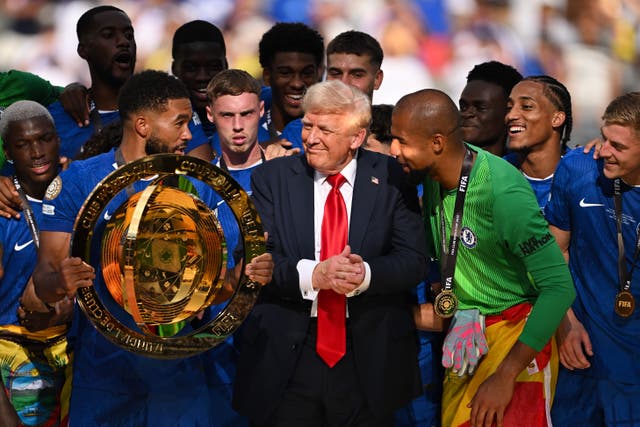
The events in New Jersey at least got everyone finally talking about the Club World Cup.
Not that you’d even consider that idea if you were listening to Infantino. On Saturday, he could talk of how billions were watching the Club World Cup – Fifa resisted some reporting of the numbers claimed – but he didn’t need to actually provide any data.
It is why numerous senior football sources talk of “the full Trumpification of Infantino and Fifa”, both in outlook and action. There’s this brazenness to everything, as old norms and standards are cast aside. Trump doesn’t even get to stand in the centre of the Super Bowl presentation.
Even before this unprecedented spectacle, Infantino had seen fit to declare that “the golden era of global club football has started”.
Such proclamations are usually reserved for the more rounded hindsight of history, or at least the peak of such eras. Not a start as uncertain as this. In this era, however, you can just say things. You don’t need evidence. No pushback will be worth much. Why listen to critical media when you can speak to IShowSpeed?
There was certainly a lot of gold on show, which entirely fit the gaudiness of the occasion. Trump even described the event as “beautiful” when he came out onto the pitch with Infantino.
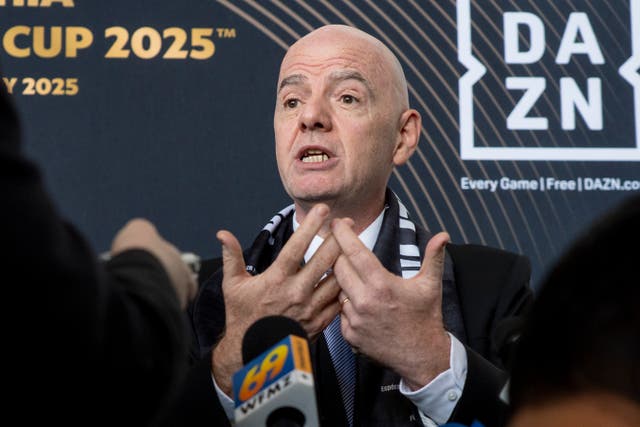
While many people in football already felt this final was a landmark moment because Infantino had proven to the clubs he could deliver a new tournament, Sunday was still seen as something more. Many were comparing the Fifa president’s tone and behaviour to just a month ago, and how it had seemingly gone to another level.
Hence FifPro describing him as “the man who thinks he is god”. Fifa’s supernational position as something like the Vatican has already been discussed in these pages.
The serious point to all of this is that, according to well-placed sources, “Infantino’s ambitions have no bounds”. Again, the Independent has reported how discussions for a biannual 48-team tournament are already afoot. Crucially, Infantino has also seen that – with the financial support of Saudi Arabia and political support of Trump – Fifa can essentially do what it wants in football. There is minimal resistance.
Many stakeholders don’t want to offer any at all. A lot of powerful people, companies and states are now invested in all of this. The big clubs are onside, which is something that Uefa and national associations like the FA should be very worried about. It’s a potential super league run by the sport’s highest authority.
And, while some on the Fifa Executive Committee were aghast at the Trump spectacle, Infantino loyalists there were loving it.

If this doesn’t necessarily end up as “a golden era”, it may well be the moment that starts profound transformation in football. An eminently logical question now is, what exactly will Infantino do next?
Sunday’s story about Fifa convening a meeting of player unions without inviting the game’s biggest player union, FifPro, was indicative because it just shows how Infantino’s Fifa now go about governance.
It is much like Trump. Just act, with the considerations of major stakeholders barely considered. The Club World Cup was implemented in the exact same way, which has led to a legal action from FifPro. “Classic post-truth politics,” as one source said.
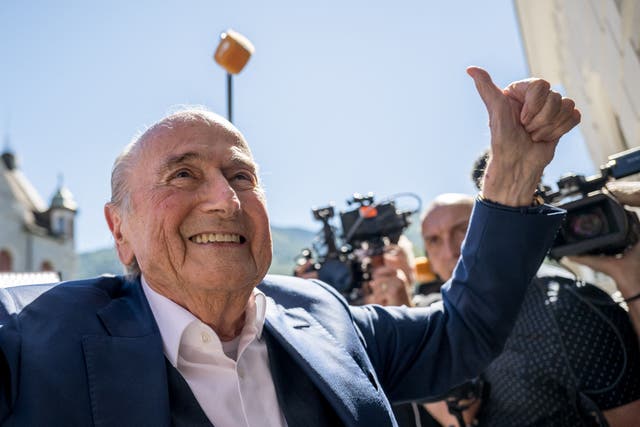
Infantino’s disgraced predecessor, Sepp Blatter, even commented on the Saudi influence here over the weekend. “We have lost football to Saudi Arabia,” the 89-year-old told German’s ntv. “We offered it, and they took it. Surprisingly, there is no opposition to this within Fifa.”
Quite. What does it say about the modern Fifa when Blatter sounds like the voice of morality and reason, and some in football now pine for his interpretation of the Fifa presidency?
Blatter’s brief visibility does raise another key point, that should be remembered. His era’s 2015 downfall was the game’s moment for true reform, with Infantino himself voted in because he was perceived as a reform candidate. He has instead accelerated down a new direction, that features classic problems.
One of the crucial factors allowing Infantino to go his own way was because the structure of Fifa didn’t change. It was still based on the same clientelistic model, with most voters – the national associations – dependent on money distribution.
That plays into why there is so little opposition to his reign now.
Uefa have been strategically outflanked, a development that warrants more discussion. The big football associations could come together, since that’s where most of the game’s “organically generated” money comes from, except their major clubs are now invested in the Club World Cup. The associations themselves are meanwhile part of the system. Many won’t speak out because they’re too dependent on Fifa money or want to host tournaments for the future. That sounds a lot like Manchester United not playing in the FA Cup in 1999-2000, because the FA wanted to host the 2006 World Cup. It’s remarkable how the same politics persist, even in the new football world.
The Fifa system allows no “opposition party” so no one wants to be in a minority opposition.
And as to why all of this matters, there is a direct link between the upward drag of the $114m Chelsea are projected to make from this tournament, and the struggles of Morecambe and Sheffield Wednesday way below them.
This ecosystem is what Fifa is supposed to be the ultimate regulator of. Instead, it currently looks like its great disruptors. It arguably made Trump’s presence all the more fitting.
