Oldest tool ever found is stick shaped by humans 430,000 years ago

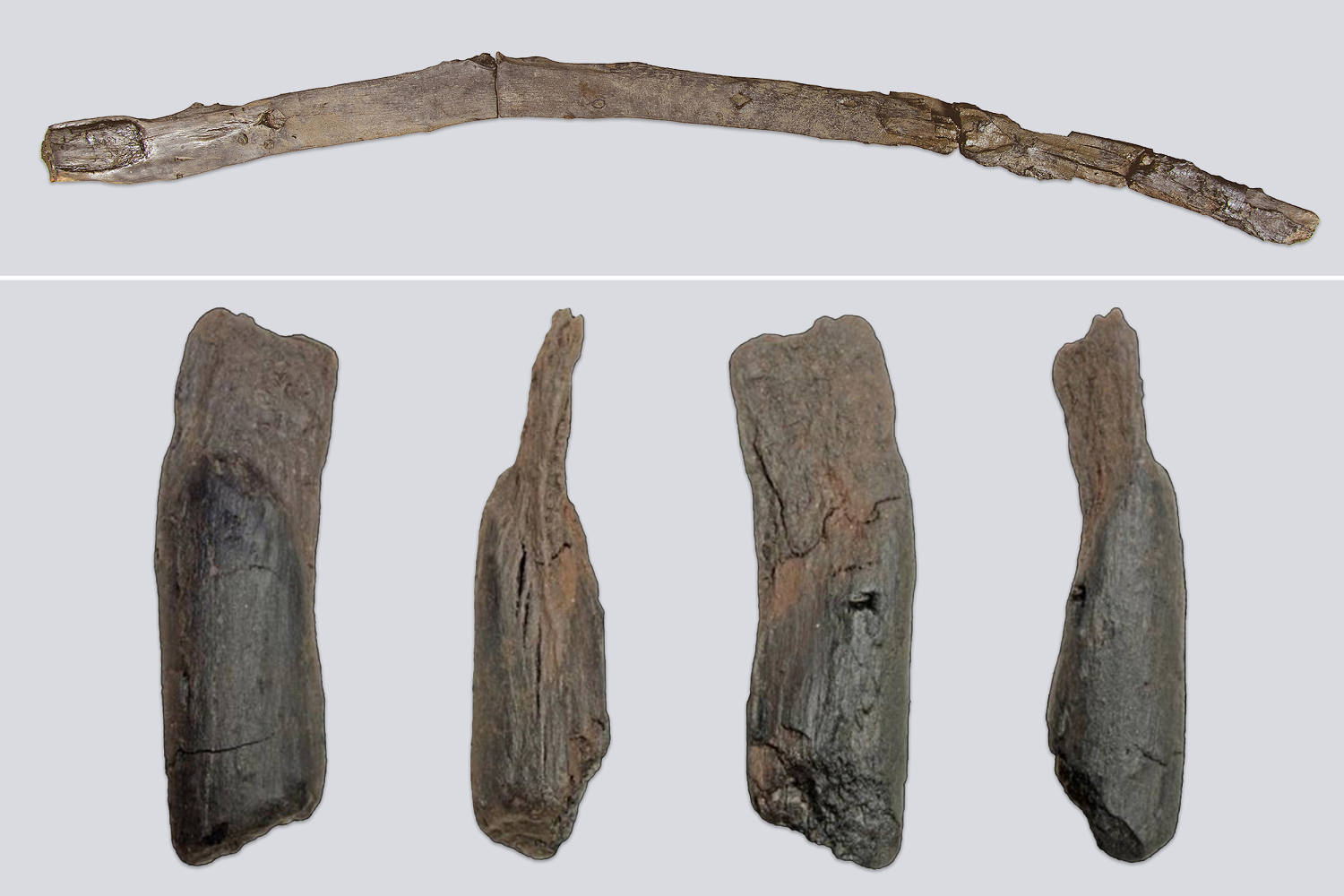
The earliest known hand-held wooden tools, used by our early human ancestors around 430,000 years ago, have been uncovered by researchers at an archeological site in Greece.
One is made from the trunk of an alder tree and could have been used for digging, and the other is a small willow or poplar artifact that may have been used to shape stones, according to a study published Monday in the journal Proceedings of the National Academy of Sciences.
“What’s particularly exciting about finds like this is that we just so rarely have wood preserved for that long,” the study’s lead author, Annemieke Milks, told NBC News by phone Tuesday.
Stone tools have been recovered by archeologists for centuries because they preserve really well, said Milks, a researcher and a leading expert in early wooden tools at the University of Reading in the United Kingdom. “So it’s really nice to be able to enrich our understanding of human evolution by finding these extremely rare objects,” she added.
Researchers have known that early human ancestors would have been also making use of wood to make tools and now there is evidence of very early use, she added.
The tools were found at a site called the Megalopolis Basin in Marathousa, Greece, about 100 miles southwest of the capital, Athens.
Once a lakeshore, it has provided evidence of other early human ancestor activity, including the making and use of stone and bone artifacts, as well as killing of elephants and other animals, according to researchers.
The smaller tool is particularly interesting, Milks said. “We have never seen anything like it,” she said, adding that they don’t fully understand its function. “It’s just really different, and it’s tiny. We’re lucky that we found it.”
Researchers know that these artifacts are not just pieces of wood by recognizing “specific marks made by stone tools on the wood itself,” she said. This “helps us to say, OK, that’s not just a stick, that’s something that humans did something with,” she added.
The methods for analysis and identification of ancient wooden tools have really accelerated in the last decade, providing an unprecedented insight into human history, Milks said.
Direct dating of organic materials, like wood, only goes back to 50,000 years ago, so researchers had to rely on dating sediment and rocks from the site itself. This allowed them to conclude that the tools date back to 430,000 years ago.
It’s likely that the unearthed wooden tools were so well preserved because they were very rapidly buried in sediment that remained wet, and kept away from microorganisms that would eat wood away or rot it, Milks said.
Conditions at the site where the tools were found are “exceptional” and allowed for preservation of delicate organic material, including wood but also seeds and leaves, Katerina Harvati, the study’s co-author, said in an email Tuesday.
The discovery highlights the importance of Greece and the Megalopolis Basin in particular for human evolution, said Harvati, a paleoanthropologist and expert in human evolution at the University of Tübingen in Germany. It provided “a very rare glimpse” into technology used by early human ancestors that researchers know almost nothing about, she said.
“They not only push back the temporal timeframe of our knowledge on this technology and expand its geographic range, but also provide new information, in the form of a completely new type of tool, which we record here for the first time,” she added.
Maeve McHugh, associate professor in classical archaeology at England’s University of Birmingham who was not involved in the study, told NBC News the findings are significant, providing an important “snapshot” into the early human ancestor activity that speaks to “how our brains were developing” in that time period.
“The fact that it’s a wooden object, an organic piece of material — it’s very rare survival outside of very arid conditions like Egypt, and particularly that it’s so old and so really at the beginning of human or early human history, I think it’s very interesting and important,” she said.
